
Tag: Operational efficiency

Designing a year-round dust control plan

article


Mining operations never stand still. Haul roads, stockpiles, and work areas are constantly exposed to changing weather conditions, heavy traffic, and environmental pressures. That means dust control can’t be treated as a one-off task – it requires a proactive, year-round plan that adapts to the seasons.

“Dust control isn’t just about reacting to dry or wet conditions. It’s about planning for the whole year,” says Johan Smit, Dust Control Application Manager at Bind-X.

A well-designed dust control strategy doesn’t just reduce emissions. It improves road safety, lowers maintenance costs, protects water resources, and supports compliance with environmental and social standards.

Here’s how to think of dust control as a continuous process rather than a seasonal scramble.

1. Understand your site conditions

Every mine is different, and your dust control plan should reflect that. Start with a comprehensive understanding of your site’s conditions:

  • Climate and seasonal patterns: does your region face long dry spells, heavy monsoon rains, or frequent seasonal shifts?
  • Soil type and composition: clay, sandy, or gravelly soils behave differently under stress and moisture. Assess gradation, fines content and plasticity index (PI), as these influence binder bonding and dust potential.
  • Traffic and layout: road length, gradient, and vehicle frequency all influence dust generation.
  • Community and compliance context: what regulations and local expectations shape your operation?

Johan emphasizes, “Every site is different. Knowing your soil, traffic, and climate is critical before choosing a dust control strategy.” Getting these factors right helps you choose prevention and control methods that are effective and cost-efficient. A good road design and preparation drastically reduce long-term costs and maintenance intervals.

2. Prevention first: road design and preparation

Stronger orads and less dust with Terrabind

The most successful dust control doesn’t begin when a binder is sprayed or water is applied—it starts with proper road design and preparation.

Grading and camber: Ensure adequate runoff and reduce erosion.

Strong base: Achieve >95% MDD compaction density to minimise surface breakdown. Moisture conditioning before binder application improves penetration and adhesion.

Drainage and buffer zones: Use ditches, culverts, and vegetated areas to manage runoff and protect nearby ecosystems.

Binder selection: Choose a product suited to your soil chemistry and climate to avoid premature degradation and rework.

3. Seasonal adaption

Dust challenges shift with the seasons. A flexible plan ensures consistent performance throughout the year.

Dry conditions: Preserve moisture, extend binder life

When rainfall is scarce and traffic is high, roads dry out quickly, leading to dust, raveling, and surface degradation.

  • High dust levels demand effective binders and careful water use. Smart binder use can reduce water consumption by up to 90% and maintain road safety.
  • Road watering alone is unsustainable and costly.
  • Schedule applications based on traffic and weather patterns for maximum impact.

“During dry periods, the biggest challenge is keeping haul roads safe without overusing water,” Johan explains. “Smart binder use can make a huge difference.”

Wet season priorities:

  • Heavy rain can wash away treatments, create potholes, and make roads unsafe.
  • Adjust curing times for moisture and temperature.
  • Wet-stable road stabilisers and binders become essential.
  • Inspect roads regularly after storms to catch issues early.

“Heavy rain can undo months of work in just a few hours,” Johan notes. “Choosing the right stabiliser before the wet season is essential.”

Transition periods:

The shift between seasons is often when roads are most vulnerable. Early inspections and adaptive scheduling prevent damage during seasonal shifts.

4. Application & technology
Stronger orads and less dust with Terrabind

How you apply a solution is just as important as what you apply.

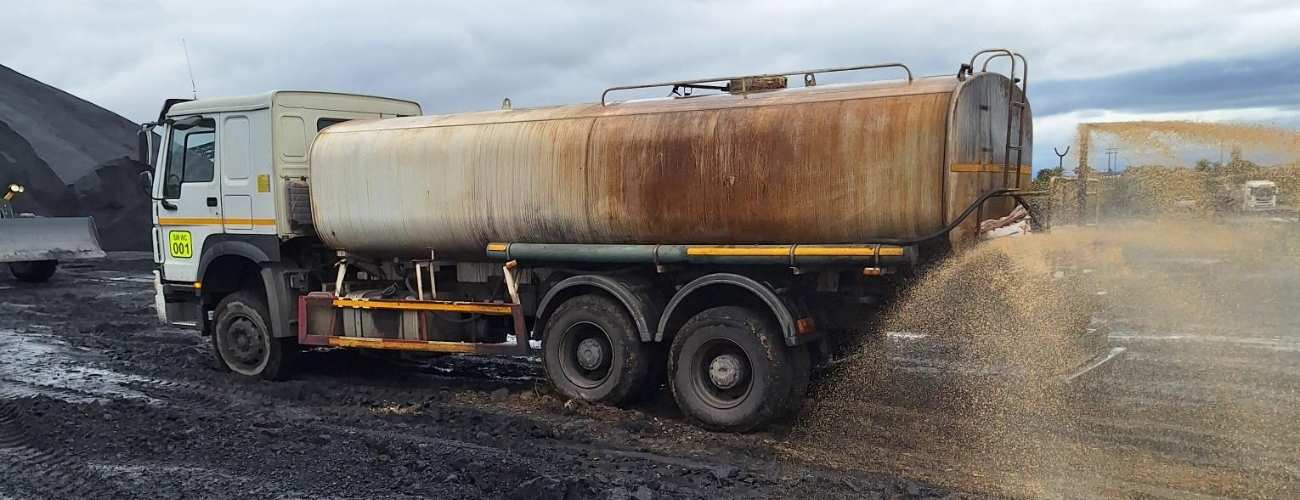
Spraying techniques: Make sure the binder is applied evenly and mixed properly to ensure effective binding and reduce the need for reapplication. Use the correct nozzles, nozzle size, spray pressure, and dilution ratio. Keep a steady speed when applying the product on the road for optimal binding.

Timing: Apply after grading, ahead of extended dry periods, or before the wet season when more stable binders are needed.

Monitoring tools: Dust sensors, drone surveys, or even basic logbooks help move from reactive to proactive management.

“It’s not about spraying more often. It’s about applying correctly and at the right time,” Johan says. “That’s where biological binders really shine.”

With biological binders, effectiveness comes from correct application and timing — not frequency. Because they create durable bonds, fewer applications are needed compared to water or salts, even across seasonal shifts.

5. Monitoring & KPIs

You can’t improve what you don’t measure. Tracking the right indicators allows you to evaluate effectiveness and adjust strategies as needed:

  • Dust levels (measured or reported).
  • Water consumption for dust suppression.
  • Road maintenance costs and frequency.
  • Number of binder applications per season.
  • Community complaints or safety incidents related to dust.

“Measuring results is just as important as applying the solution,” Johan adds. “Without tracking dust, water use, and road condition, you can’t improve your strategy.”

Keeping a seasonal log or digital dashboard ensures decisions are based on real data rather than assumptions.

6. Building a long-term strategy

Dust control works best when it’s part of a long-term plan rather than a short-term fix:

Budgeting as investment: Dust control reduces vehicle wear, accidents, and environmental risks – saving money in the long run.

ESG alignment: Dust reduction improves environmental performance and supports social license to operate.

Continuous improvement: Reviewing data annually ensures strategies evolve with site conditions.

Conclusion

A year-round dust control plan combines prevention, adaptation, monitoring, and long-term thinking. By tailoring strategies to site conditions and seasonal shifts, mines can reduce costs, improve safety, and operate more sustainably.

“‘A year-round plan protects not just the operation, but the people and environment around it,’ Johan concludes. “That’s the real value of proactive dust control.”

At Bind-X, we help mines design dust control solutions that work in every season – with biological binders that last longer, use less water, and protect the environment. Talk to our team about how to create a tailored dust control strategy for your operation.

Case Insight: Sustainable impact in practice

This approach is not just theoretical. At an open-pit mine in South Africa’s Northern Cape, implementing a seasonal dust control plan with the biological binder Terrabind™ reduced water consumption by 90% and extended road lifespan by 85%. The proactive strategy improved air quality, reduced vehicle wear, increased tyre life, lowered maintenance costs, and strengthened community trust—demonstrating the tangible benefits of planning dust control for the full year.

Topic

Topic

Find out about biological dust control for your site

Enquire now

Continue reading

One switch transformed dust control at a manganese operation

article


Dust control wasn’t the problem. But maintenance was losing its grip.

The manganese operation had been managing its haul roads with a familiar choice: a bitumen emulsion blend. The haulage roads were in a decent condition, the dust levels down, and the product was widely available. But beneath that apparent success, operations were paying the price.

Clogged tanks. Thick residue on trucks and equipment. Cleaning cycles for equipment and tanks caused delays of up to two weeks. The blockages meant the mine lost control over its road maintenance, and the roads themselves began to suffer.

“Bitumen emulsions may initially appear to be an attractive dust control solution, but they often lead to significant operational challenges and additional hidden costs. In mining, operations rarely run perfectly, and the added burden of cleaning out chemical tanks, managing cleaning logistics, and falling behind on essential road maintenance is best avoided,” says JC Le Roux, Head of Business Development Africa at Bind-X.

Loooking for performance — without the problems

The mine’s Mine Planning Engineer understood there had to be a better way. The mine wasn’t just seeking something more environmentally friendly. They required a solution that maintained the same road performance without causing downstream damage.

That’s when they tested Terrabind™ Max, a biological dust control product whose advanced solidification process creates robust, high-compressive strength roads capable of withstanding the harshest conditions, reducing maintenance requirements and extending the lifespan of both equipment and infrastructure.

“What stood out about this team was their willingness to challenge the status quo,” JC says. “They weren’t only looking for something ‘green’. They wanted something better operationally.”

Bitumen emulsion in a water bowswr that is clogged

Immediate impact, measurable change

The biological solution matched the dust control performance and road stability, without the complications:

  • No tank blockages
  • No equipment buildup
  • No unplanned maintenance
  • No off-site tank cleaning
  • No delays in product deliveries

Even during extreme conditions on site, the team could respond quickly, without any of the old bottlenecks. Reapplication was simple and immediate, without delays or cleaning logistics.

One year later: reliable, efficient, and clean

One year into using Terrabind™ Max, the mine reports significantly improved road maintenance operations. No equipment damage. No tank cleaning.

“This isn’t just about sustainability,” JC concludes. “It’s about uptime, asset longevity, and freeing up resources. The mine made a smart, forward-looking move — and it’s paying off.”

Topic

Topic

Find out about biological dust control for your site

Enquire now

Continue reading

Is dust control risking your license to operate?

article


In areas like Western Australia’s Pilbara, groundwater is a shared resource, relied on by local communities, Indigenous custodians, farmers, and ecosystems. And while your site might be compliant, that’s no longer the whole story.

“Staying within your licence isn’t enough anymore. You can still lose support on the ground,” says Martin Krehenbrink, from Bind-X. “We’ve seen the impacts of this recently in the Pilbara in Western Australia.”

Groundwater under scrutiny

Earlier this year, the Robe River Kuruma people raised serious concerns about the impact of groundwater extraction from aquifers in the Bungaroo Valley, water connected to sacred sites.

The ABC News report says that mining operations have drawn up to 10 billion litres a year from the area since 2014. Groundwater levels have dropped by half in just a decade. The result? Dry riverbeds, dead trees, and damage to culturally significant landscapes.

While dust suppression isn’t named directly, it’s part of the picture. And one of the easiest areas to target for immediate water savings.

“We can’t just talk about compliance anymore,” says Martin. “We need to demonstrate that we’re thinking about long-term water stewardship and cultural heritage.”

Dust control: A silent water drain

Dust suppression is often treated as a background task. But it’s a thirsty one.

Spraying plain water on haul roads can quietly consume millions of litres each week. At some sites, it accounts for more than 30% of total water use. Yet it’s rarely monitored or reported on separately.

That creates a blind spot, not in your compliance report, but in public perception.

“The real risk isn’t about breaking the rules,” Martin explains. “It’s about losing trust. If you’re not in front of the issue, someone else will be.”
In a region where every drop is becoming increasingly scarce, it’s what you do with each litre that counts.

From compliance to conservation

According to Martin, a molecular microbiologist who works closely with mine sites around Australia, it’s time to treat dust control not just as a maintenance task, but as a conservation opportunity.

“Dust control has to align with your broader sustainability strategy,” says Martin. “It can’t be the exception.”

Water spraying might feel like business as usual, but it’s wasteful, short-term, and increasingly hard to justify. Other options are available, and some newer technologies on the market are achieving good results.

Biological road stabiliser used on a haul road

A smarter way forward

Some mining companies are already proving what’s possible.

At one site, ArcelorMittal switched to a biological dust control method using a clean, biological product called Terrabind. Instead of regular water sprays, this solution binds fine particles on the haul road, keeping dust down for longer with significantly less water.
The impact? A 75% reduction in water use for dust suppression. You can read the full case here.

The approach doesn’t just conserve water. It also extends the life of haul roads, reduces fuel and maintenance costs, and shows a proactive commitment to environmental responsibility.
It’s a cleaner alternative to older technologies like polymers, and bitumen emulsions, which come with their own challenges. It’s worth considering the newer wave of dust control alternatives out there.

Haul road dust suppression may not be the biggest issue on your ESG radar. But it’s one of the few where you can make a visible, measurable improvement—quickly.

Every litre saved sends a message that your site takes stewardship seriously.

Where to start: Key questions for your site

  • Are you tracking water use for dust suppression separately?
  • Have you benchmarked usage per kilometre of haul road?
  • When did you last assess alternative control methods?
  • Are Indigenous water concerns part of your site’s risk assessment?
  • Do your sustainability reports reflect haul road water usage?

Dust suppression doesn’t need to be a blind spot in your sustainability strategy.

Your licence to operate depends not just on legal compliance, but on leadership. Especially when it comes to visible, localised impacts like water use.

Topic

Topic

Find out about biological dust control for your site

Enquire now

Continue reading

More water trucks won’t fix your dust problem

article


Across Australian and African mine sites, operations continue to rely on untreated water as their primary dust control method, despite clear evidence of its limitations. Plain water evaporates within hours, creating a costly cycle of reapplication that strains resources without delivering lasting results.

“The mining industry has historically defaulted to ‘just add more water trucks’ when dust problems persist,” notes Martin Krehenbrink, CEO at Bind-X. “But forward-thinking site managers are now questioning whether plain water, regardless of application frequency, is fundamentally the right tool, given increasing water scarcity.”

Why spraying more water falls short

On paper, watering haul roads might appear low-cost and straightforward. But its effects wear off fast, often within 20 to 40 minutes. This creates a constant, resource-intensive loop with high fuel and water use: 3 to 4 trucks per shift, especially during the dry season.

The problem doesn’t stop at inefficiency. Plain water on its own damages road surfaces, compromises safety, and disrupts operations. Too much water means operators face slippery conditions, wet ruts, and potholes. Tyre wear increases. Maintenance teams are left fixing the very roads the water is supposed to protect.

“Water trucks are out in force, but they’re not solving the root problem. In many cases, they’re making it worse by degrading the roads,” says Martin. “We’ve seen haul speeds drop purely because of wet, greasy conditions.”

One method doesn’t fit all

Each part of your site has unique dust dynamics. In-pit areas may respond well to water. But static surfaces, like bunds and stockpiles, require longer-lasting suppression. And heavy-traffic haul roads benefit from stabilisation rather than repeated wetting.

Yet many sites still rely on one method, spraying plain water, as the primary dust control method, regardless of traffic volume, dust generation rate, or reapplication effort. It’s easy to default to water trucks. They appear to get the job done. But in reality, you’re spending time, fuel, labour and water, just to chase a problem around the site.

“Smarter dust control starts with zoning,” says Martin. Not every part of the site generates dust the same way. “In-pit at the active face, plain water with cannons works, sure. A well-timed wetting strategy can keep things under control.”

“But when it comes to your high-traffic haul roads, and areas like bunds, stockpiles, ROM edges, or rehab zones, these aren’t places you should be hitting with a water truck every few hours,” he says.

For those zones, you need a set-and-forget approach. Ideally you would use biological binders or soil stabilisation products that create a crust or binding layer that lasts for weeks or even months, depending on conditions.

“But it should be environmentally safe and re-minable at a later time,” explains Martin.

“When we see sites step back and treat dust control the way they treat any operational risk, by assessing cause, exposure, and impact, better decisions follow. The progressive ones are already doing this.”

You spend less, get better results, and free up your crews to focus on higher-value work.

Stronger orads and less dust with Terrabind

A smarter approach

Newer technologies now offer the same durability as older methods like bitumen emulsions, salts and polymers, without the environmental downsides. One example is Terrabind, a biological dust control method that uses natural  processes to form a solid cement-like layer on the wearing course. It keeps dust in place without oil, polymers, or synthetic resins.

Once applied, it penetrates the surface and holds dust down through heat, wind, and even rain. It’s biologically safe and scalable.

“We’ve helped sites cut water usage by 75%, and some up to 90%,” says Martin. “Removing water trucks from haul roads not only reduces water use, it eliminates unnecessary interactions with dump trucks and speeds up haul cycles.”

Eramet reduced road water usage by 85% with a biological dust control approach at their Grande Côte Opérations (GCO) in Senegal. In 2022, the mining services team realised they were spraying over 242,000 litres of water per day on the roads just to keep dust under control. They wanted to reduce water consumption, so the business proactively decided to test other options. The team found that Terrabind reduced water usage by 85% and created a three-fold drop in dust fallout. You can read more about that story here.

Measure first. Then take action.

Before you default to more water, pause and assess what’s really happening onsite. With the right data, you can make smarter, targeted decisions:

  • Use dust monitors to pinpoint hot spots
  • Schedule your drones to regularly assess surface conditions and track dust movement
  • Conduct visual audits to measure effectiveness by zone
  • Stabilise haul roads with environmentally safe binders

“Smart sites are moving from firefighting to forward planning,” says Martin. “They’re using technology like dust monitors, drones, and data to decide where and when to act.”

The solution isn’t just running water trucks, it’s a new mindset. Treating dust control as a strategic process instead of a reactive routine opens the door to better performance, lower costs, and safer roads.

Because if you’re just spraying water, you’re not solving the problem. You’re delaying it.

Topic

Topic

Find out about biological dust control for your site

Enquire now

Continue reading

Are water trucks slowing down your haul road cycle times?

article


Water trucks substantially impact haul road cycle times—and yes, we can measure it. According to Tannant & Regensburg who wrote a manual on mining haul road design, road surface conditions and rolling resistance directly affect truck performance.

Impact on haulage time

Water truck slowdowns might seem minor at first glance, but they add up dramatically across your fleet. 

Think about a typical 15-truck operation. Each haul truck encounters water trucks 8-12 times per shift, with each interaction causing 45-90 seconds of delay. That’s 20-30 minutes of lost time per truck, per shift. Multiply that across your fleet, and you’re looking at 4-6 hours of total fleet delay every shift.

This significantly hurts production. A baseline cycle time of 22 minutes jumps to 28-32 minutes when you factor in water truck interactions. Over a shift, each truck in your fleet loses 2-3 complete cycles. And the disruption goes beyond just time loss. Water trucks create unpredictable bottlenecks, especially on ramps and at loading and dumping zones. When a water truck services these critical areas, queues of up to four trucks can form, triggering a cascade of delays.

These traffic flow disruptions hit hardest in high-congestion areas. Single-lane ramp sections see delays of 60-90 seconds when water trucks are present. Loading and dumping zones experience 2-3 minute delays during water application.

With haul trucks, every minute of delay hits your bottom line. Let’s look at a typical 1.6km haul on flat ground with 1.8 minutes combined loading and dumping time.

Tannant & Regensburg point out that on a well-maintained road with 4% rolling resistance, a loaded CAT 793C truck’s combined travel time is 4.7 minutes. However, when road conditions deteriorate to 10% rolling resistance, that same combined travel time nearly doubles to 9.5 minutes. This increases the total cycle time from 6.5 minutes to 11.3 minutes—a dramatic impact on productivity that can cost your operation millions in lost production annually.

Biological dust control creates stable roads and gets water trucks off mine roads

Getting water trucks off the road

But here’s the good news: there’s a better way. Forward-thinking operations like Eramet’s Grand Côte are getting water trucks off the road by implementing modern dust control strategies that use biocementation to strengthen the road. These long-lasting surface treatments can reduce water truck frequency by up to 90%.

What does this mean for you? Your operations teams don’t need to worry about strategic application timing, focused on night shifts and planned around peak production periods, to minimise interference with day shift hauling.

Operations that have made the switch report cycle time improvements across their haul road network. The results speak for themselves: cycle time improvements of 3-5 minutes and an additional 1-2 loads per truck per shift.

Implementation strategy for faster cycles

“In practice, many Australian mines are finding success with hybrid approaches,” says Martin Krehenbrink, Managing Director at Bind-X. “They’re using road stabilisers which keep dust down on main haul roads while maintaining traditional watering on temporary roads and around loading areas. The key is matching the method to your specific site conditions.”

He suggests you consider running a trial to see the benefits for yourself.

Measure and develop a test plan

“We suggest that you start by measuring and analysing your current situation,” says Martin. “Begin by tracking the frequency and duration of water truck encounters across your haul network.”

Document cycle time variations related to these interactions and identify your most problematic bottlenecks. Then calculate the production impact in terms of loads per shift to build a compelling business case.

Next, select 2-3 km of your highest-traffic haul roads for initial testing with road stabilisation treatments,” explains Martin. Choose stabilisers appropriate for your site conditions and establish clear baseline metrics. Set measurable success criteria that focus on cycle time improvements and production increases.

Martin recommends you consider cleaner options now widely available, like biological dust control, which uses a biocementation process. This proven treatment employs naturally occurring microorganisms to bind soil particles together, creating a more stable road surface. Beyond reducing water truck requirements, biocementation is clean for the environment, unlike older technologies like crude-oil-based bitumen emulsions, salts, or polymer-based products.

Conduct controlled dust control trials

“When we run trials on site, we show operators how to apply the product and how to monitor performance,” says Martin. “Many are surprised when they go from applying water 15x per day, to then only spraying once every couple of days after they’ve applied Terrabind biological dust control.”

He suggests documenting all results carefully, including cycle times, dust levels, and operator feedback. Then, calculate your return on investment based on production increases versus implementation costs.

During the trial phase, we train your operators on new procedures using existing water trucks and equipment already on site, and help you establish ongoing performance monitoring,” explains Martin.

Every minute saved in your haul cycle translates directly to improved production. By addressing the hidden impact of water truck dependencies, you can discover significant gains in operational efficiency. The question isn’t whether water trucks are slowing down your cycle times—it’s by how much, and what you’re going to do about it.

How is your site managing the balance between dust control and cycle time efficiency?

Topic

Topic

Find out about biological dust control for your site

Enquire now

Continue reading